Vietnam to Africa Pet Relocation: Complete Guide
Relocating a pet from Vietnam to Africa is one of the most complex international pet transport scenarios.
Unlike Europe or North America, Africa has:
Highly variable import regulations
Limited airline options for live animals
Complex routing constraints
However, one route consistently enables these movements:
Vietnam → Addis Ababa (Ethiopia) → Africa
This guide explains:
The best flight route for pets to Africa
Veterinary export requirements from Vietnam
Import rules for key African countries
Risks, timelines, and planning considerations
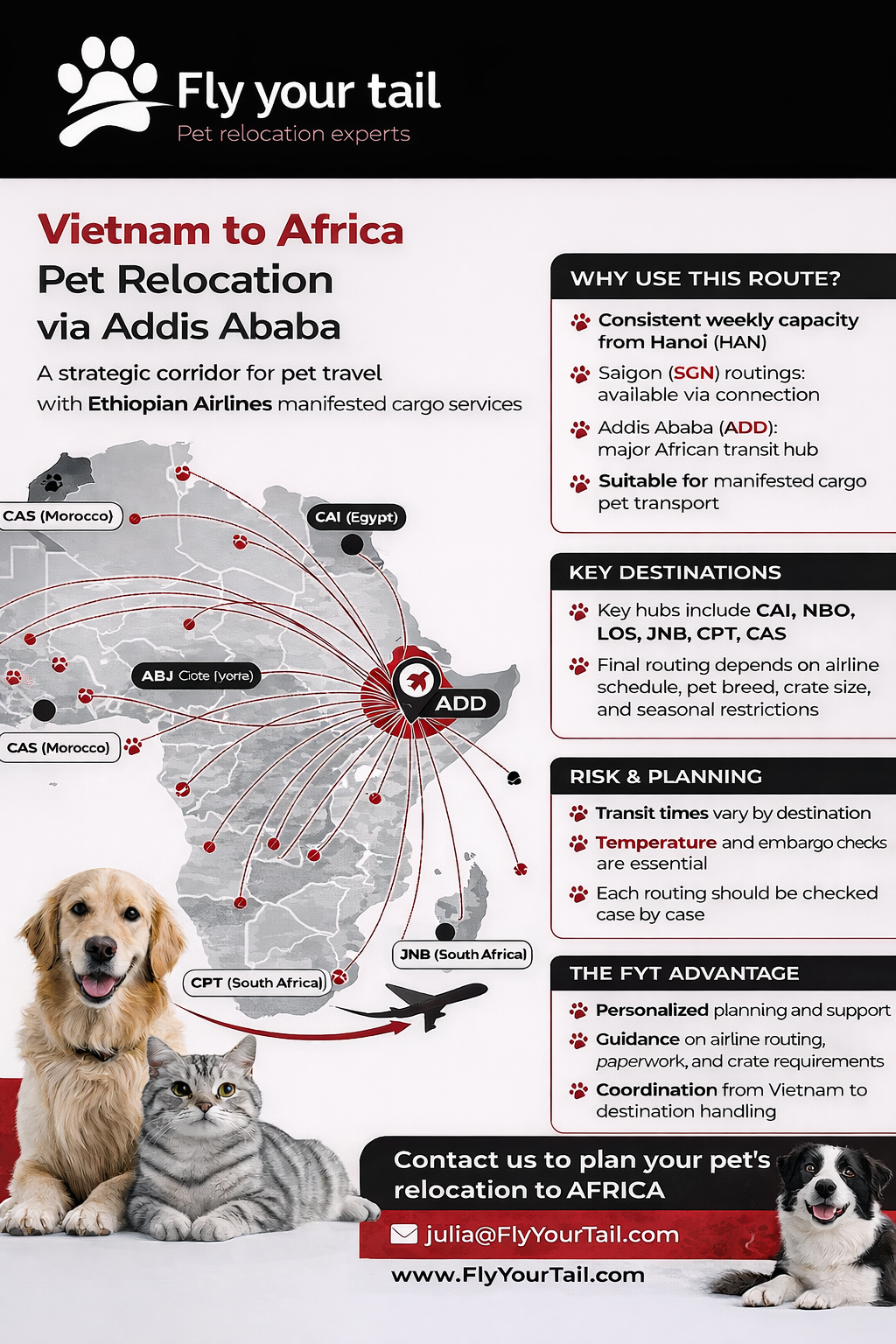
Best Route for Pet Relocation: Vietnam to Africa via Addis Ababa
The most reliable way to transport pets from Vietnam to Africa is through Addis Ababa (ADD) using Ethiopian Airlines.
Why this route works
Consistent weekly capacity from Hanoi (HAN)
Wide African network coverage
Airline experienced with live animal transport (AVI cargo)
Single-hub connection simplifies logistics
From Addis Ababa, pets can connect to:
Nairobi (NBO) – Kenya
Johannesburg (JNB) – South Africa
Cairo (CAI) – Egypt
Lagos (LOS) – Nigeria
Casablanca (CAS) – Morocco
Important note about Saigon (SGN)
No equivalent direct frequency
Shipments typically require:
Connection routing
Or repositioning to Hanoi
How Pets Travel to Africa (Cargo vs Cabin)
For most African destinations, pets must travel as:
Manifested Cargo (AVI)
This means:
Pet travels under an airway bill (AWB)
Handled via cargo terminals
Required for countries like South Africa
In-cabin travel is generally not possible for Africa routes.
Veterinary Requirements to Export a Pet from Vietnam
Export requirements from Vietnam are standardized but must be executed precisely.
1. Microchip
ISO-compliant (15-digit)
Must be implanted before rabies vaccination
2. Rabies Vaccination
Minimum 30 days before travel
Must be valid at time of entry
3. Core Vaccinations
Dogs:
Distemper
Parvovirus
Hepatitis
Leptospirosis
Cats:
FVRCP (Rhinotracheitis, Calicivirus, Panleukopenia)
4. Parasite Treatment
Internal + external
Usually within 5–7 days before departure
5. Veterinary Health Certificate
Issued by a licensed vet in Vietnam
Typically within 7 days before departure
6. Government Endorsement (if required)
Some destinations require certification by the Department of Animal Health
Pet Import Requirements by African Country
Each African country has different rules. Below are the most relevant destinations.
Kenya (Nairobi – NBO)
Requirements:
Import permit
Rabies vaccination
Veterinary health certificate
Key points:
No quarantine if compliant
Relatively fast processing
One of the easiest African destinations
South Africa (Johannesburg – JNB / Cape Town – CPT)
Requirements:
Import permit (mandatory)
Health certificate (strict format)
Rabies vaccination
Additional blood tests (dogs)
Important:
Pets must travel as cargo
Quarantine may apply (≈14 days)
Longer preparation timeline
SEO keyword target: pet relocation South Africa requirements
Egypt (Cairo – CAI)
Requirements:
Rabies vaccination
Health certificate
Key points:
No rabies titer test required
Simpler import process
Nigeria (Lagos – LOS)
Requirements:
Import permit
Health certificate
Rabies vaccination
Operational note:
Procedures can be inconsistent
Local agent coordination is essential
Common Requirements Across Africa
Most countries will require:
Import permit
Valid rabies vaccination
Veterinary health certificate
Advance documentation approval
Risks When Relocating Pets to Africa
Understanding risks is critical for planning.
1. Transit Time
Typically 12–30+ hours
Depends on connection timing in Addis Ababa
2. Temperature Restrictions
Airlines may embargo pets due to:
Weather
Breed (especially brachycephalic)
3. Documentation Errors
Incorrect paperwork can result in:
Entry refusal
Quarantine
Delays
4. Route Variability
Not all routes are available year-round
Capacity changes frequently
How Long Does It Take to Relocate a Pet to Africa?
Typical timeline:
Veterinary preparation: 2–8 weeks
Permit processing: 3–14 days
Flight booking: 1–3 weeks
Total: 3 to 10 weeks depending on destination
Cost of Pet Relocation from Vietnam to Africa
Costs vary significantly based on:
Destination country
Pet size and crate dimensions
Airline routing
Veterinary requirements
General estimate:
$1,000 – $4,000+ per pet
South Africa tends to be on the higher end due to testing and compliance.
Why This Route is the Most Strategic Option
The Addis Ababa corridor offers:
Access to 60+ African airports
Centralized transit hub
Strong cargo airline network
Feasibility for complex routes
Without this route, many African relocations would not be possible.
How Fly Your Tail Supports Your Pet Relocation
At Fly Your Tail, we focus on:
Route feasibility assessment
Veterinary timeline planning
Airline coordination and booking
Documentation verification
Destination clearance coordination
We do not rely on “standard routes”—each relocation is planned individually.
Conclusion: Is Pet Relocation to Africa Possible?
Yes—but it requires:
Correct routing
Precise documentation
Careful timing
The Vietnam → Addis Ababa → Africa corridor remains the most effective solution, but success depends on expert planning.
Contact Fly Your Tail
If you are planning to relocate your pet to Africa, we can assess your case and provide a tailored plan.
📩 julia@flyyourtail.com
🌐 www.flyyourtail.com