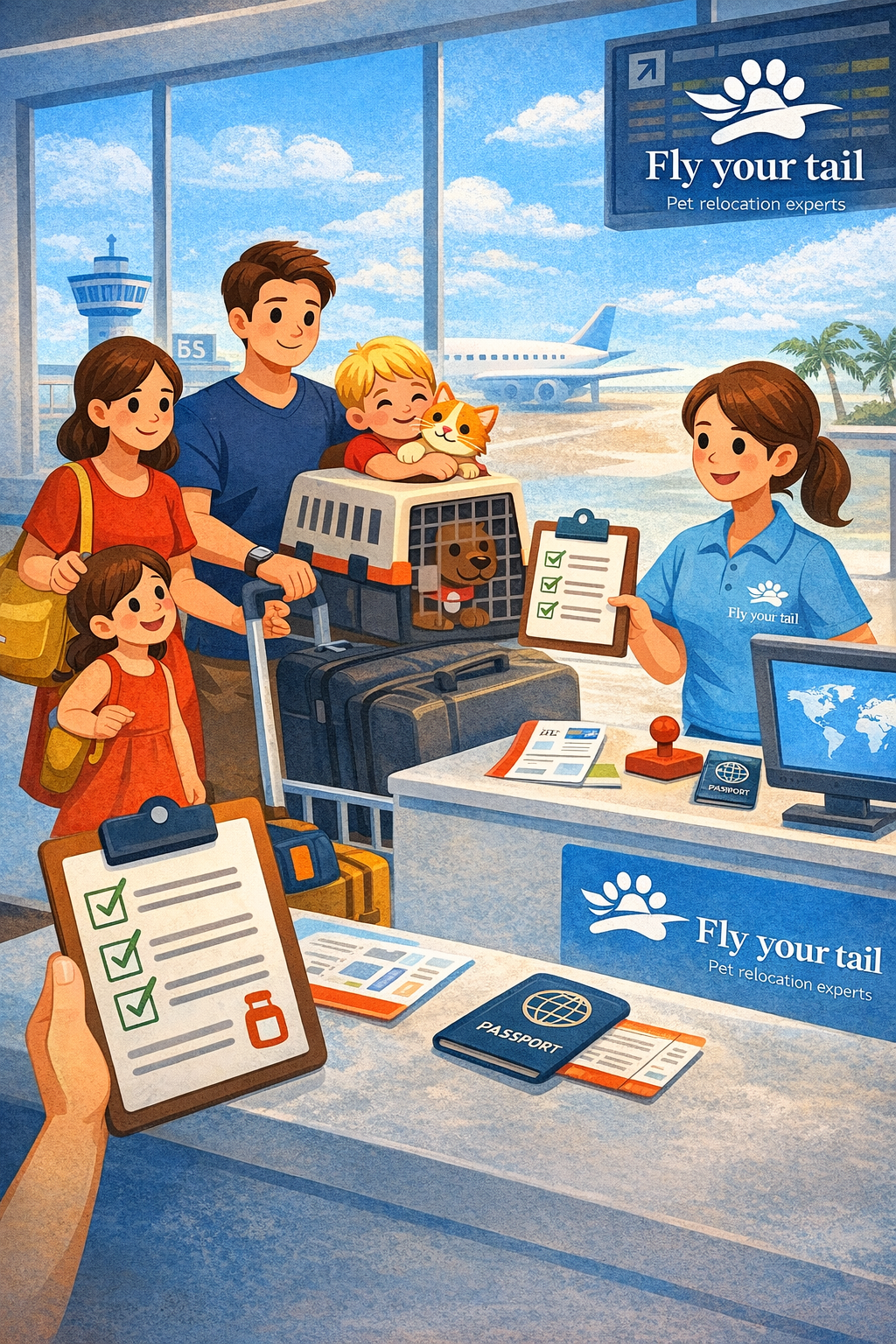
How to Plan an International Relocation with Kids and Pets
Relocating internationally is rarely simple.
When you add children and pets to the equation, it becomes a highly coordinated process where timing, documentation, and logistics must align perfectly.
At Fly Your Tail, we regularly support families through this transition, and one thing is clear: the difference between a smooth relocation and a stressful one is planning.
This guide breaks down how to approach a move with both kids and pets in a structured, practical way.
1. Start Planning Earlier Than You Think
One of the most common mistakes families make is underestimating timelines.
Pet relocation alone can take several weeks depending on the destination. When combined with family logistics—school schedules, visas, and travel planning—you should ideally allow 6 to 12 weeks.
A key challenge is that some pet documents (such as health certificates) are only valid for a few days before travel. This means everything—your flights, your paperwork, and your family’s readiness—must align precisely.
2. Define Your Travel Strategy First
Before booking any flights, you need to decide how the journey will actually work.
Key questions include:
Will the whole family travel together, or will you split responsibilities?
Will your pet travel in cabin or as cargo?
How many connections are involved?
In many cases, the most effective approach is:
One adult focuses on the pets
One adult focuses on the children
This reduces stress during check-in, security, and transit.
3. Choose Airlines Strategically
Not all airlines handle pets equally, and not all routes are suitable for families.
You should prioritize airlines that:
Have consistent pet acceptance policies
Offer smooth transit processes
Operate through airports with clear pet handling procedures
At the same time, consider the experience for your children:
Avoid tight connections
Choose routes with manageable travel times
Look for airlines that support families (boarding, seating, etc.)
A well-chosen route can significantly reduce overall stress.
4. Manage Two Parallel Documentation Processes
Relocating with kids and pets means managing two independent but interdependent systems.
For pets:
Microchip
Rabies vaccination
RNATT (rabies titre test), if required
Export health certificate
Import permit (depending on country)
For children:
Valid passports
Visas or residency permits
Relevant travel or vaccination documents
The complexity lies in timing.
All documents must be valid at the same moment of travel.
5. Prepare Your Children for the Journey
Children are often the most overlooked part of relocation planning.
Explain clearly:
What will happen at the airport
Why the pet may travel separately
When they will be reunited
From a practical perspective:
Bring familiar items (toys, blankets)
Prepare for waiting times
Plan for in-flight comfort and entertainment
Reducing uncertainty helps keep the entire journey calmer.
6. Prioritize Crate Training for Your Pet
If your pet is not comfortable in their travel crate, relocation becomes significantly more difficult.
Crate training should begin at least 2–3 weeks before travel and include:
Spending time inside the crate daily
Sleeping in the crate
Remaining calm with the door closed
This is not only about comfort—it is often a requirement for airline acceptance.
7. Pack Strategically
Think beyond standard luggage. You are effectively managing three different types of passengers.
Pet essentials:
Absorbent bedding
Water containers
All documents (originals + copies)
Children’s essentials:
Change of clothes
Snacks
Entertainment
Parent essentials:
Centralized document folder
Digital backups
Emergency contacts
Organization at this stage prevents issues later.
8. Plan Arrival Logistics in Advance
Arrival is often the most demanding part of the journey.
Before departure, you should have clarity on:
Pet clearance procedures at destination
Transportation that accepts pets and children
Pet-friendly accommodation
Trying to arrange these details after landing adds unnecessary stress.
9. Build Buffer for Delays
Delays are not uncommon, and with children and pets, they can quickly become more complex.
To mitigate risk:
Choose flights with sufficient connection time
Avoid last departures of the day
Allow flexibility in your schedule
Planning for delays is part of good planning.
10. Consider Professional Support
Relocating with kids and pets is one of the scenarios where professional guidance adds the most value.
The process involves:
Regulatory compliance
Airline coordination
Timeline alignment
Real-time problem solving
A relocation consultant ensures that all elements are aligned from the beginning and provides support throughout the journey.
Final Thoughts
Relocating with your family and your pets is not just a logistical process—it is an emotional one.
With proper planning, it can be a smooth transition. Without it, small mistakes can quickly escalate into delays, added costs, or unnecessary stress.
Approaching the move as a structured project rather than a last-minute arrangement makes all the difference.
Planning a relocation with kids and pets?
At Fly Your Tail, we design each relocation step by step—ensuring that pets and families arrive safely and with minimal stress.
📩 julia@flyyourtail.com
🌍 www.flyyourtail.com