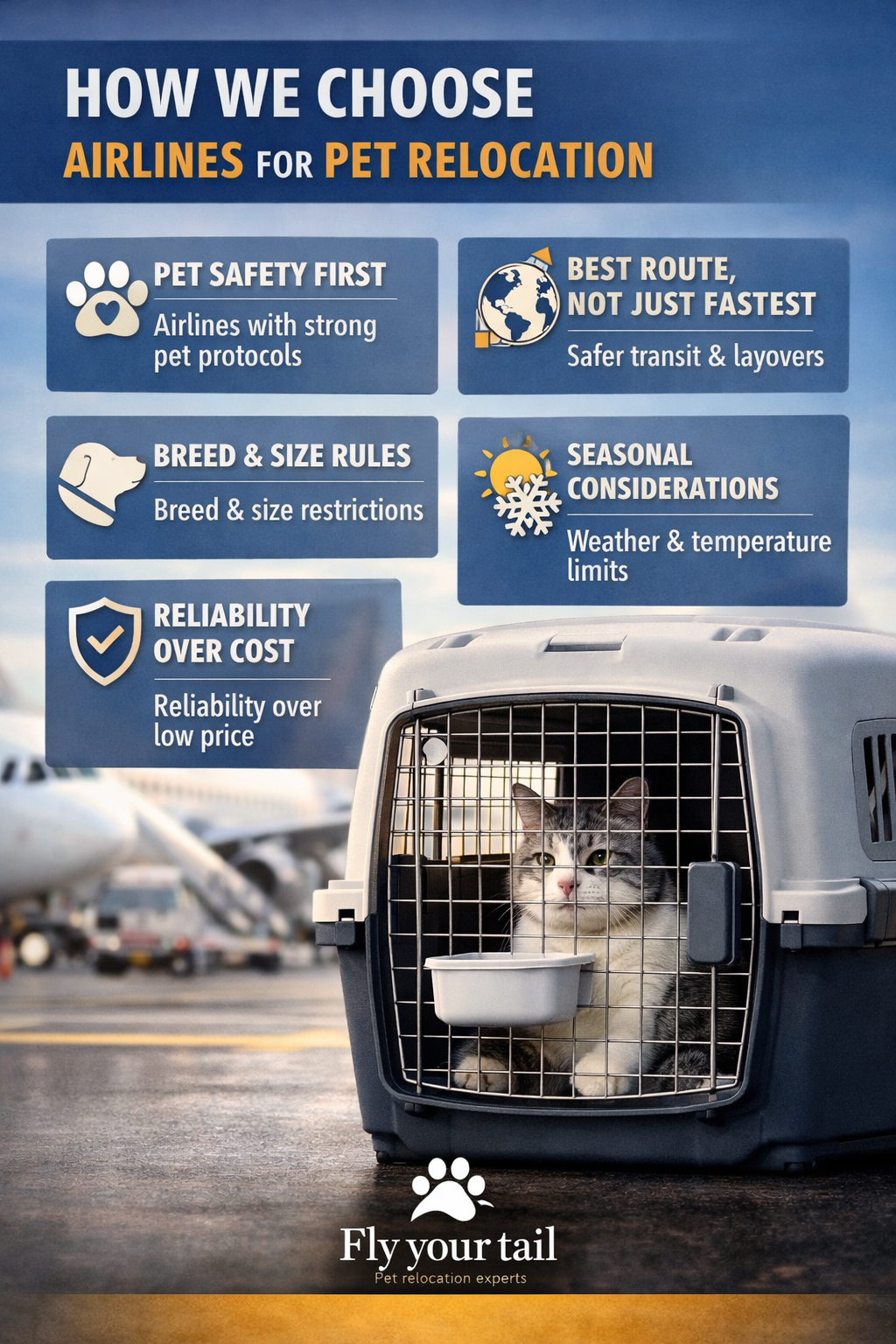
How We Choose the Right Airline for Your Pet Relocation
When planning an international pet relocation, most people assume the process is simple: find a flight, book it, and prepare the paperwork.
In reality, one of the most critical decisions—and one that can directly impact your pet’s safety—is choosing the right airline.
This is not just a logistical step.
It is a risk management decision.
At Fly Your Tail, we evaluate each case individually. There is no “one airline fits all” approach. Below is how we make that decision.
1. Not All Airlines Handle Pets the Same Way
Airlines differ significantly in how they manage live animals (AVI shipments).
Some have:
Dedicated live animal handling teams
Temperature-controlled holding areas
Structured loading and transfer procedures
Others operate with more limited infrastructure.
We prioritize airlines with proven handling standards, because your pet is not just cargo—it’s a living animal that requires controlled conditions at every stage of the journey.
2. Route Design Matters More Than Speed
It’s common to assume that the fastest route is the best option.
In pet relocation, this is often not the case.
We carefully evaluate:
Transit airport facilities
Layover duration and conditions
Frequency and reliability of the route
A slightly longer itinerary with a pet-friendly transit hub is often safer and less stressful than a shorter route with poor handling conditions.
3. Breed, Size, and Aircraft Compatibility
Every airline has its own policies regarding:
Breed restrictions (especially brachycephalic dogs)
Maximum weight limits (pet + kennel)
Accepted kennel dimensions
Even when two airlines operate the same route, their policies can differ significantly.
Choosing the wrong airline can result in:
Last-minute refusal at check-in
Delays in travel
Additional unexpected costs
We match your pet’s breed, size, and kennel requirements with airlines that can safely accommodate them.
4. Temperature and Seasonal Restrictions
Weather plays a major role in pet travel.
Airlines impose strict temperature limits to protect animals during:
Ground handling
Loading and unloading
Transit periods
For example:
High temperatures may lead to embargoes in certain regions
Extremely cold conditions can also restrict travel
We analyze temperatures at:
Origin
Transit points
Destination
…and select routes that minimize exposure to risk.
5. Reliability Over Cost
Cost is always a factor—but in pet relocation, it should not be the primary one.
Lower-cost options may involve:
Less reliable schedules
Limited support for live animals
Higher risk of delays or mishandling
A slightly higher investment often translates into:
Better coordination
More predictable timelines
Lower overall risk
In our experience, reliability is one of the most important factors in a successful relocation.
6. Experience From Real Cases
After coordinating multiple international relocations, certain patterns become clear:
Which airlines consistently deliver high standards
Which transit hubs are well-equipped for pets
Which routes tend to create operational issues
This knowledge cannot be found in airline brochures—it comes from real cases, real challenges, and real outcomes.
Choosing the Right Airline Is About Reducing Risk
Pet relocation is not just about getting from one country to another.
It’s about ensuring your pet travels:
Safely
Comfortably
Without unnecessary complications
Choosing the right airline is one of the most important steps in that process.
Need Help Planning Your Pet’s Journey?
If you’re unsure which airline or route is best for your pet, professional guidance can make a significant difference.
At Fly Your Tail, we plan each relocation with a focus on safety, compliance, and peace of mind.
📩 julia@flyyourtail.com
🌐 www.flyyourtail.com