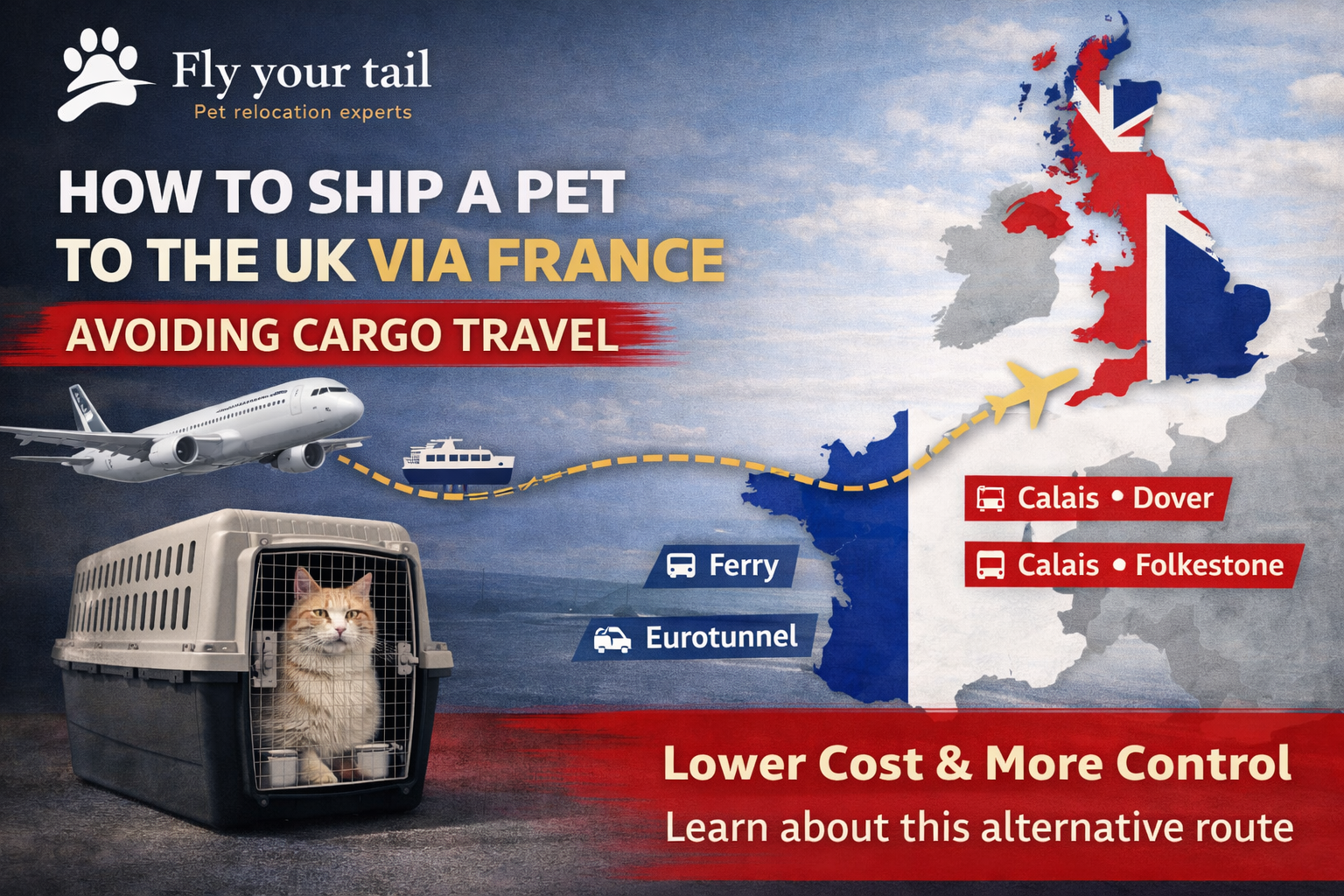
How to Ship a Pet to the UK via France (Avoiding Cargo Travel)
Relocating a pet to the United Kingdom can be more complex than other destinations.
One of the main challenges is that the UK does not allow pets to arrive in-cabin or as excess baggage. Pets must enter the country as manifested cargo, which is often more expensive and less flexible for owners.
However, there is a well-established alternative route that many pet owners use:
👉 Flying into France and then traveling to the UK by land
This option can significantly reduce costs and give owners more control over the journey.
Why Pets Must Enter the UK as Cargo
The United Kingdom has strict import regulations under the Pet Travel Scheme.
Pets entering the UK must:
Arrive as manifested cargo
Land at approved Border Control Posts
Undergo document and identity checks upon arrival
Because of this, airlines do not allow pets to enter the UK in the cabin or as excess baggage, even if the pet is small.
For many owners, this is where the France route becomes a practical alternative.
The Alternative: Flying to France First
Instead of flying directly to the UK, pets can:
Fly to France (Paris or another EU airport)
Travel as cabin or excess baggage (depending on airline and size)
Continue the journey to the UK by road
France follows EU pet travel rules, which are more flexible than UK regulations.
This allows pets to avoid cargo travel completely.
How the France to UK Route Works
Once your pet arrives in France, the journey continues by land.
Option 1: Ferry (Calais → Dover)
Pet stays with the owner in the vehicle
Requires pre-booking with an approved ferry company
Pet documentation is checked before boarding
Option 2: Eurotunnel (Calais → Folkestone)
Faster option (approx. 35 minutes crossing)
Pets remain inside the vehicle
Pet reception and document check at the terminal
Both options are part of the UK Pet Travel Scheme, meaning pets can enter the UK legally without flying as cargo.
Requirements for Entering the UK via France
Even when traveling via France, UK requirements still apply.
Your pet must have:
✔️ Microchip (ISO compliant)
✔️ Valid rabies vaccination
✔️ EU Animal Health Certificate or EU Pet Passport
✔️ Tapeworm treatment (for dogs, 24–120 hours before entry)
Any mistake in documentation can result in refusal at the border, so accuracy is critical.
Cost Comparison: Cargo vs France Route
While every case is different, the cost difference is often significant.
Direct Cargo to UK:
Typically 3,000 – 5,000 USD per pet
Includes cargo handling, airline fees, and clearance
Via France:
Approximately 1,000 – 2,000 USD per pet
Includes flight as baggage + road transport
👉 The France route is often more cost-effective and more flexible, especially for families traveling with their pets.
Advantages of the France Route
Choosing this route offers several benefits:
• Lower overall cost
• Possibility to travel on the same flight as your pet
• Less stressful journey for many animals
• More control over timing and logistics
For many pet owners, this option feels more “hands-on” and reassuring.
Important Considerations
This route is not completely simple and still requires proper planning.
You must consider:
Airline acceptance policies (breed, size, temperature)
Correct kennel sizing (IATA compliant)
Coordination between flight arrival and UK entry timing
Validity of all documents at each step
Even small errors can cause delays or additional costs.
Is This Option Right for You?
The France route works best if:
✔️ You want to avoid cargo travel
✔️ Your pet is eligible to fly in cabin or as baggage
✔️ You are comfortable with a multi-step journey
✔️ You want a more cost-effective solution
For some cases (large pets, complex routes, certain breeds), cargo may still be the only viable option.
Final Thoughts
Shipping a pet to the UK does not always have to mean cargo.
By flying into France and continuing by land, many pet owners can choose a more flexible, cost-effective, and controlled journey.
The key is understanding the process — and planning every step carefully.
Need Help Planning Your Pet’s Journey?
Every relocation is different.
If you are considering bringing your pet to the UK and want to explore the best option for your specific case, feel free to reach out.
📩 julia@flyyourtail.com
🌐 www.flyyourtail.com